
Are LED Neon Signs Safe to Use Indoors?
Yes. LED neon signs are one of the safest forms of decorative lighting available. They operate on low voltage (12V DC), stay cool to the touch, contain no toxic materials, and are shatterproof. They are safe for bedrooms, kids' rooms, nurseries, kitchens, offices, and any indoor space.
LED Neon Safety at a Glance
| Safety Concern | LED Neon | Traditional Glass Neon |
|---|---|---|
| Operating voltage | 12V DC (same as a car battery or USB charger) | 2,000-15,000V AC (high voltage, shock risk) |
| Surface temperature | Cool to touch (under 100°F / 38°C) | Hot (can reach 150°F / 65°C, burn risk) |
| Breakability | Flexible silicone tubing, virtually unbreakable | Fragile glass tubes, shatters into sharp pieces |
| Toxic materials | None — silicone, acrylic, copper wiring | Contains mercury and/or argon gas |
| UV radiation | None | Minimal (from phosphor excitation) |
| Fire risk | Extremely low (runs cool, low wattage) | Low-moderate (heat + high voltage) |
| Noise | Silent | Audible buzzing from transformer |
| Safe near children? | Yes | No — heat, glass, high voltage |
| Safe near pets? | Yes | No — breakable, hot surface |
Why LED Neon Is Safe: The Details
Low Voltage Operation
LED neon signs run on 12V DC power — the same voltage as a car battery, a laptop charger, or a USB port. This is classified as Safety Extra-Low Voltage (SELV) by electrical safety standards, meaning it cannot deliver a harmful electric shock under normal conditions. Even if the wiring were somehow exposed (which the silicone jacket prevents), 12 volts cannot push enough current through human skin to cause injury.
For comparison, traditional glass neon operates at 2,000-15,000 volts AC. While the current is low, this voltage can cause painful shocks and, in rare cases, serious injury — especially in damp environments like bathrooms or outdoor settings.
Cool Running Temperature
LED neon tubing generates minimal heat. After running for 8+ hours continuously, the surface temperature stays below 100°F (38°C) — warm to the touch but not hot enough to cause a burn. This is because LEDs convert most of their energy into light rather than heat (approximately 80% light, 20% heat).

Glass neon tubes, by contrast, can reach 150°F (65°C) or higher — hot enough to cause a contact burn, especially dangerous for children who may touch the sign out of curiosity.
Shatterproof Construction
LED neon uses flexible silicone tubing that bends, flexes, and absorbs impact without breaking. If a sign falls off the wall, the tubing won't shatter. The acrylic backing may crack on severe impact, but it breaks into large, dull-edged pieces rather than sharp fragments.
Glass neon tubes are exactly what they sound like — thin glass tubes that shatter into sharp, dangerous shards. A fallen glass neon sign creates an immediate safety hazard from broken glass, plus potential mercury exposure from the gas inside the tubes.
No Toxic Materials
LED neon signs contain:
- Silicone tubing (food-grade silicone in premium signs)
- Acrylic plastic backing (non-toxic, recyclable)
- Copper wiring (standard electrical wiring)
- LED semiconductor chips (non-toxic solid-state components)
- ABS plastic housing for the power adapter
No mercury, no lead (RoHS compliant), no toxic gases, no volatile organic compounds. LED neon signs can be disposed of as regular electronic waste and are recyclable.
Room-by-Room Safety Guide
Bedroom
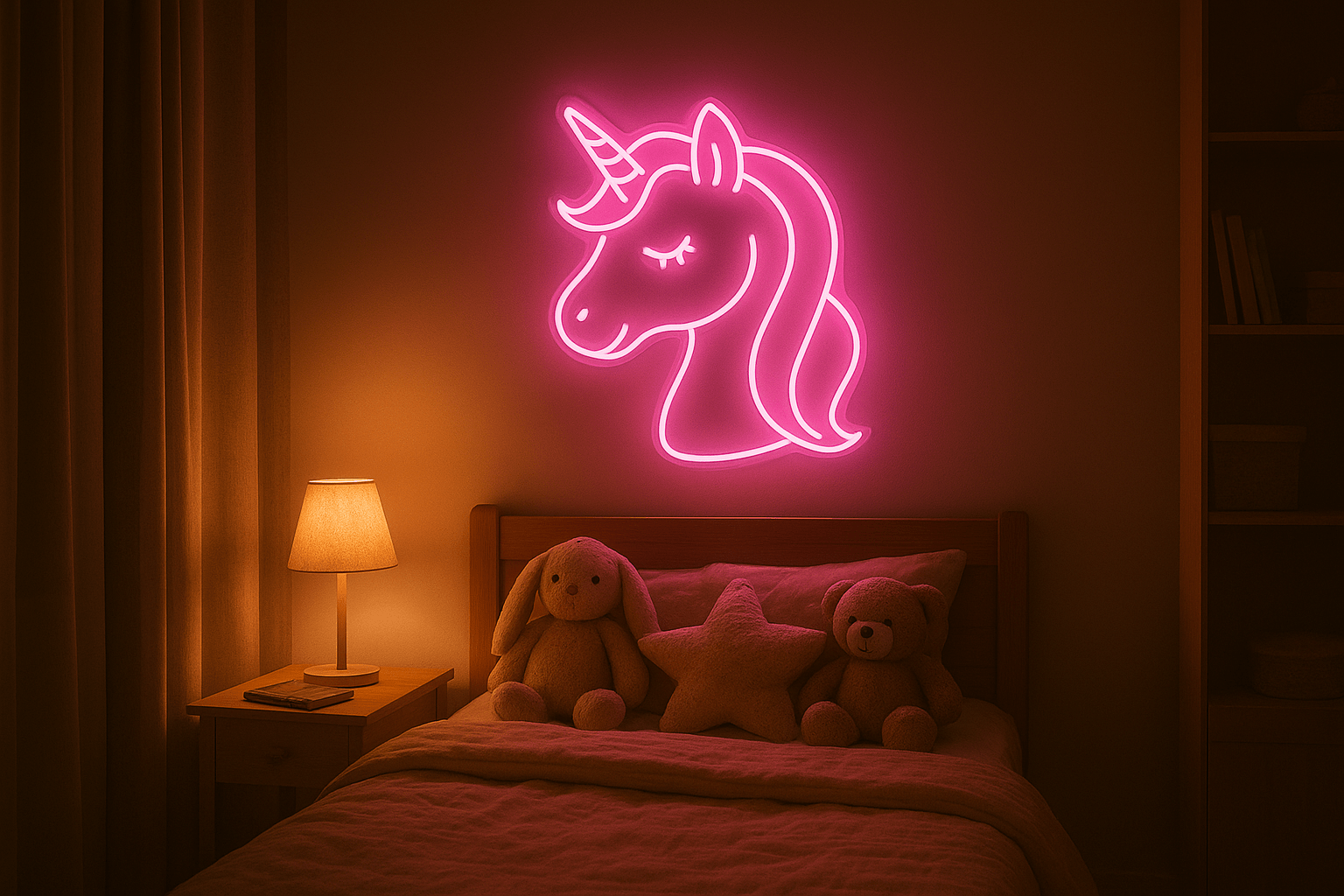
Safe: Yes. LED neon is ideal for bedrooms. The low heat output means it won't warm the room. The dimmer switch lets you lower brightness for ambient nighttime lighting. Silent operation means no buzzing to disturb sleep. Many people use LED neon signs as nightlights — at 20-30% brightness on the dimmer, they provide a soft glow that's bright enough to navigate the room without being disruptive.
Children's Room / Nursery
Safe: Yes. LED neon is one of the best lighting options for kids' rooms. Cool surface (no burn risk), shatterproof (no glass hazard), low voltage (no shock risk), and no toxic materials. Mount the sign high enough that small children can't pull on the power cord. Consider using a cord cover or cable channel to route the cord safely along the wall.

Kitchen
Safe: Yes, with placement consideration. Standard indoor LED neon signs are not waterproof. Mount them away from the sink, stove, and any area that gets splashed with water or exposed to steam. Avoid placing directly above a stove or oven where heat rises. For areas near water, choose an outdoor-rated (IP65+) sign.
Bathroom
Safe: With the right product. Standard indoor LED neon signs should not be used in bathrooms where they'll be exposed to shower steam or splashed water. For bathroom use, choose an IP65-rated (waterproof) sign. Mount it away from the shower/bathtub area. Even waterproof signs should not be submerged or placed directly in the shower.
Home Office
Safe: Yes. LED neon works well in offices. No flickering (which can cause eye strain and headaches with fluorescent lights), no buzzing noise, and dimmable brightness. Position the sign to the side or behind your monitor rather than directly in your line of sight to avoid glare during video calls.
Man Cave / Game Room
Safe: Yes. This is one of the most popular rooms for neon signs. The low heat output means they're safe near electronics, gaming consoles, and upholstered furniture. Multiple signs can run simultaneously without significant heat or electricity load.
Business / Commercial Space
Safe: Yes. LED neon signs meet commercial safety requirements in virtually all US jurisdictions. The UL-listed power adapter and low-voltage operation comply with the National Electrical Code for decorative lighting. No special permits or electrician installation required for standard plug-in LED neon signs.
Certifications and Standards
Quality LED neon signs carry these safety certifications:
- UL listed (power adapter) — Tested and certified by Underwriters Laboratories for electrical safety
- CE marked — Meets European safety, health, and environmental requirements
- RoHS compliant — Free of restricted hazardous substances (lead, mercury, cadmium, etc.)
- FCC compliant — Does not emit harmful electromagnetic interference
- IP20 rated (standard indoor) — Protected against solid objects over 12mm
- IP65 rated (outdoor models) — Protected against water jets from any direction
Common Safety Questions
Can LED neon signs cause a fire?
The fire risk from LED neon signs is extremely low. They operate at 12V DC with typical power consumption of 10-30 watts (less than a standard light bulb). The surface stays cool, and there is no exposed filament or flame. That said, basic electrical safety applies: don't use a damaged power cord, don't cover the sign with fabric or curtains while it's on, and use a surge protector.
Can I leave LED neon on overnight?
Yes. LED neon signs are designed for extended continuous operation. Many businesses and homeowners run them overnight without issues. The power consumption is minimal (typically under $0.50/month running 24/7) and the heat output is negligible. If you prefer, use a timer or smart plug to automate on/off schedules.
Are LED neon signs safe for pets?
Yes. The cool surface means no burn risk if a pet touches or rubs against the sign. The silicone tubing is flexible and won't shatter if a pet knocks the sign. The low-voltage wiring won't cause harm even if chewed (though you should discourage wire chewing as a general practice). The main concern is the power cord — route it along the wall using cord covers to prevent tripping and chewing.
Do LED neon signs emit harmful radiation?
No. LED neon signs emit visible light only. No ultraviolet (UV) radiation, no infrared (IR) radiation beyond the minimal heat output, and no ionizing radiation of any kind. They do not contribute to sunburn, skin damage, or any radiation-related health concern.
Are cheap LED neon signs safe?
Not always. Ultra-cheap signs (under $30 from unverified sellers) may use uncertified power adapters, poor-quality wiring, or non-fire-retardant plastics. Always check that the power adapter is UL-listed or has equivalent certification. Buy from established retailers who provide warranty and safety documentation. The sign itself (LED tubing on acrylic) is inherently safe, but the power adapter is the component where safety cutting corners becomes dangerous.
Sources & References
Last updated: April 2026.
How Much Do Neon Signs Cost in the USA? A Quick Pricing Guide
How long will the LED neon sign last?